
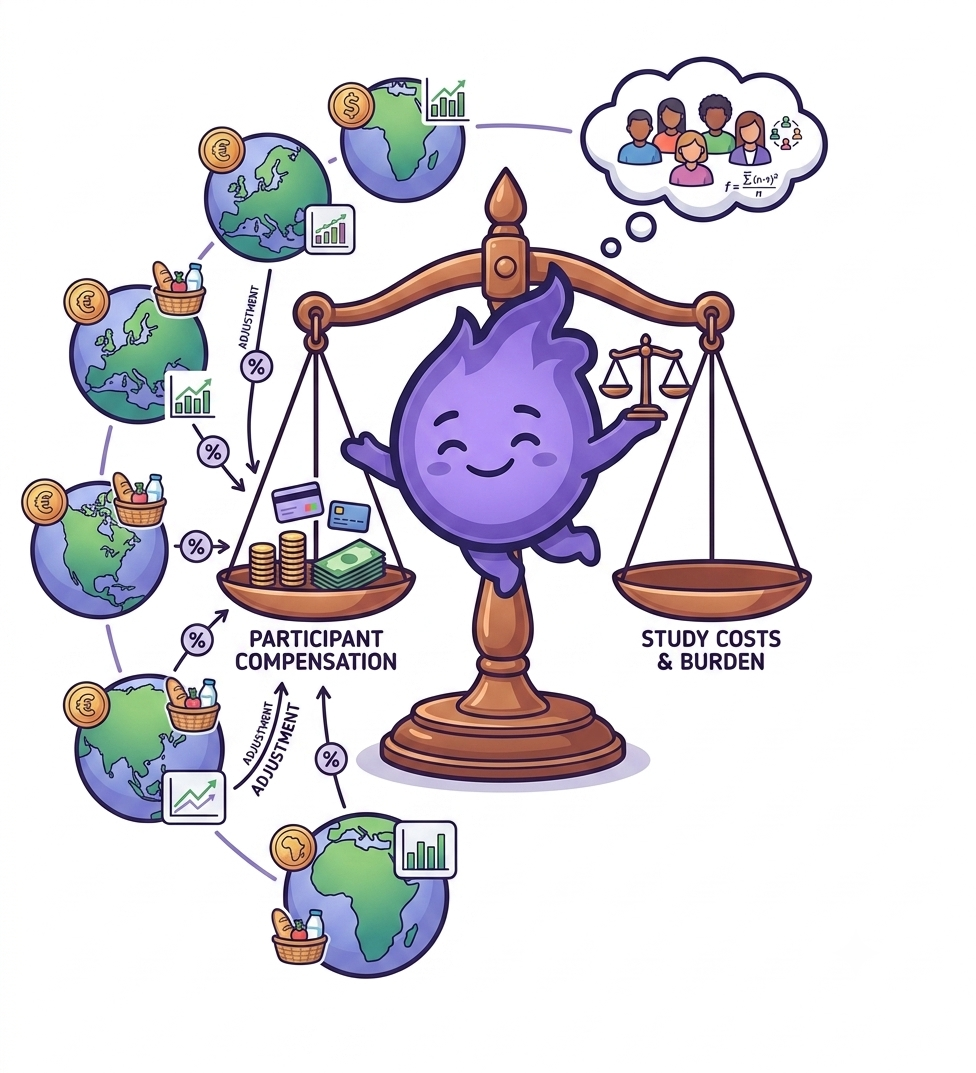
Designing fair participant compensation for multi-country studies
Compensation is one of the first practical questions in any study, and one of the easiest to get wrong once a study runs across more than one country. A payment that feels like fair recognition of someone's time in one setting can look negligible in another, or, at the opposite extreme, substantial enough to pressure someone into joining who otherwise wouldn't. Getting this wrong doesn't just create awkward conversations. It can affect recruitment, retention, and how an ethics committee views the study altogether.
Part of the difficulty is that "fair" isn't a fixed number. It depends on local cost of living, typical hourly wages, how much time and travel the study actually asks of someone, and what a reasonable person in that setting would consider proportionate rather than persuasive. A flat global rate avoids the appearance of favouritism between sites, but it can end up under-compensating participants in higher-cost regions while over-compensating in others, which is its own kind of unfairness.
Separate reimbursement from incentive
These are two different things, and treating them as one tends to cause most of the confusion. Reimbursement covers costs a participant wouldn't otherwise have: travel, parking, childcare, time off work. Incentive is compensation for the burden of taking part at all. Ethics reviewers generally expect reimbursement to be close to exact, while incentive is where proportionality and local context matter most. Being explicit about which is which makes the reasoning easier to defend and easier for participants to understand.
Build in local review, not just central approval
A rate set centrally and applied everywhere rarely holds up well once it reaches individual sites or countries. Local research teams, and where possible participant representatives, are usually better placed to judge whether a rate reads as respectful or as pressure in their specific context. One paper examining participant payment during the COVID-19 pandemic made the case directly: reasonable payment is not just permissible but often necessary, since without it participation risks becoming the preserve of people who can afford to volunteer for free.
Keep the logistics as simple as the ethics
Multi-currency payments, tax reporting obligations, and different banking norms can turn a well-designed compensation plan into a burden that falls on participants rather than the study team, for example a delayed payment or a bank transfer that never arrived. Whatever payment method is chosen should be tested from the participant's side, in the country they are actually in, before it is relied on at scale.
Document the reasoning, not just the rate
An old but still relevant piece on the ethics of paying research subjects made a point worth repeating: it is not the amount of a payment that determines whether it's coercive, but the reasoning behind it and how transparently that reasoning is applied. Recording why a given rate was chosen for a given country, and reviewing it periodically as costs change, gives a study something to point to if the question is ever raised, rather than having to justify it after the fact.
Fair compensation across multiple countries will rarely mean identical numbers everywhere. It means the same principle applied consistently: enough to respect a participant's time and costs, without becoming the reason they said yes.