
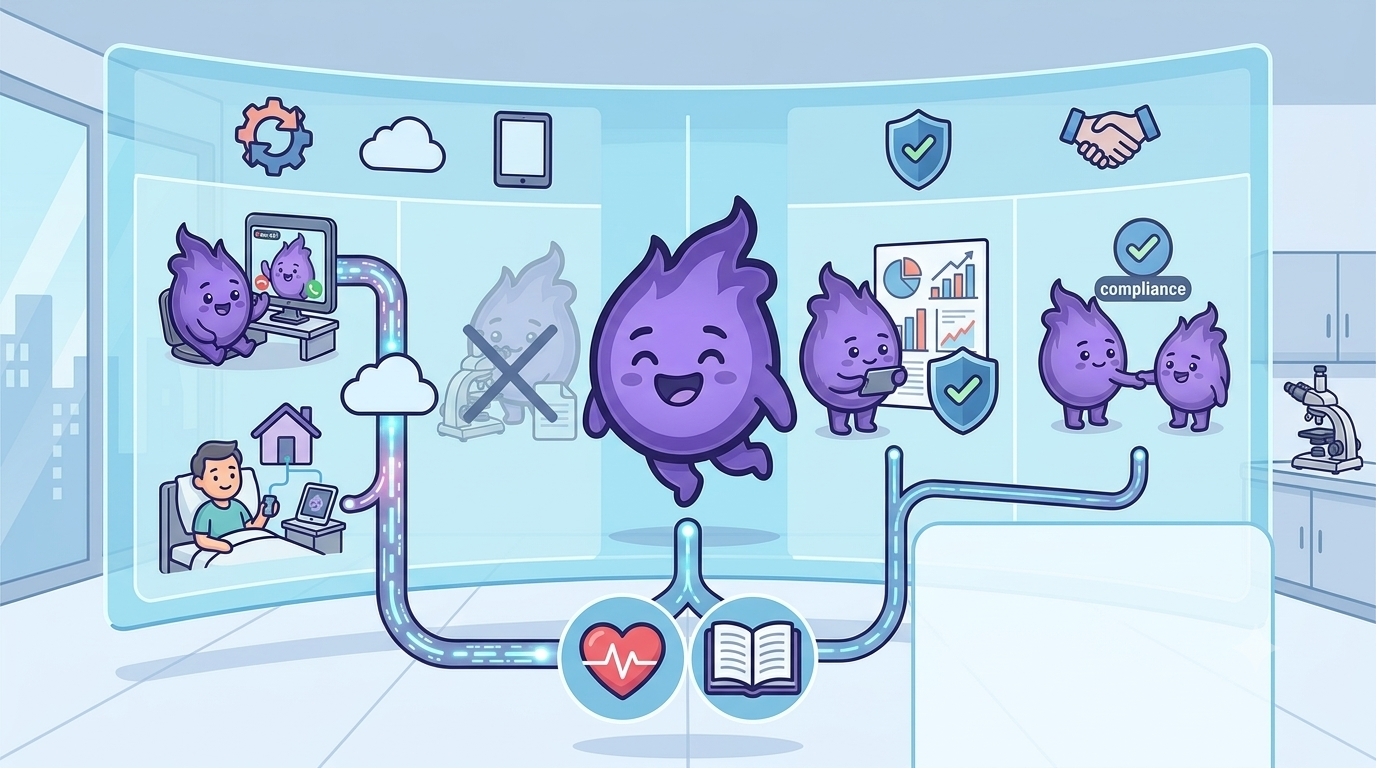
Running a study with no sites: what changes, what doesn't
The idea of running a study with no physical sites is appealing. No travel. No binders. No coordinating across six time zones to align visit windows. But the assumption that follows, that virtual means simpler, tends to catch teams off guard.
Even the terminology around this model is unsettled. A review looking specifically at the confusion between "virtual," "digital," "remote," and "decentralised" trials found the inconsistency itself was a problem, hampering discussions between stakeholders who each meant something slightly different by the same word. The review's proposed fix was to settle on "decentralised clinical trial" as the standard term for an approach built around the participant rather than the investigator site, which is worth adopting even informally, since half of getting this model right is being precise about what it actually involves.
Virtual trials are different in structure, not lighter in effort. Every weak point that a site normally absorbs becomes visible when the physical infrastructure disappears.
What genuinely changes
| Area | What normally happens at a site | What happens without one |
|---|---|---|
| Participant engagement | Face-to-face visits, in-clinic data capture | Video calls, shipped study kits, app and wearable data |
| Monitoring | Physical site visits, source document review | eCRFs and system logs, reliant on digital audit trails |
| Team structure | Local coordinators handle local issues | Centralised team absorbs volume from every participant |
How participants engage. Video calls replace face-to-face visits. Study kits are shipped to homes. Data flows in through apps and wearables rather than being captured by a coordinator in the room. This opens the study to participants who would never travel to a clinic, which is genuinely valuable, and a wider review of decentralised trial benefits found the model measurably reduces drop-out rates alongside improving access. But it also creates logistical demands that sites would normally handle: kit delivery, device troubleshooting, local lab coordination.
How monitoring works. Without physical site visits, monitoring moves to eCRFs and system logs. This increases reliance on digital audit trails and places more weight on how well the platform captures context: who entered what, when, and why. The monitor still needs to understand what happened. The difference is that everything they need must exist in the system.
How teams are structured. Traditional site coordinator roles tend to consolidate into centralised teams. That can create bottlenecks if workflows are not designed carefully. In a site-based study, different coordinators handle different local issues naturally. In a virtual study, the central team handles everything, and volume adds up.
What stays exactly the same
Some things do not change regardless of delivery model:
- Participants still need responsive support when something goes wrong
- Protocols still need to be detailed, clear, and followed
- Regulatory obligations around data protection and eligibility do not diminish
- The core research questions, inclusion criteria, and ethical requirements all remain
These are not things that virtual delivery makes easier. They are things that virtual delivery requires the same rigour around, in a different format.
Why fully decentralised isn't always the answer
The same benefits review that found improved retention and faster timelines also pointed toward a hybrid approach as the more durable model, combining remote elements with in-person components where they genuinely add value, rather than removing sites entirely as a point of principle. That's consistent with what shows up operationally: some assessments, some participant populations, and some safety monitoring genuinely need a person in the room, and a study that could use a hybrid design but insists on being fully virtual just relocates that need somewhere less well suited to handle it.
The honest trade-off
Virtual trials demand more upfront planning. Questions that sites would once answer on the fly, like what to do if a participant cannot log in or what happens if a kit arrives damaged, need documented answers before the study starts.
The payoff is real: broader reach, reduced burden on participants, and faster recruitment in many cases. But the path to that payoff runs through careful design, not an assumption that removing the clinic removes the complexity.