
What self-reported adherence data actually gets wrong
Self-reported data is convenient in a way that's easy to forget is also a source of risk. It's cheap to collect, participants generally understand what's being asked, and it doesn't require any hardware. It's also, in at least one well-documented case, wrong often enough to change who should have been eligible for a trial in the first place.
A striking mismatch from a real pragmatic trial
The MedISAFE-BP trial recruited participants online, screening for poorly controlled hypertension based on what people reported about their own blood pressure. When those same participants had their blood pressure measured objectively at home after enrolment, 64% turned out to have a systolic reading below 140 mm Hg, the threshold used to define poorly controlled hypertension in the study. In other words, nearly two-thirds of people who described themselves as having a condition the study was specifically screening for didn't, in fact, have it by the objective measure that mattered.
The researchers went further than just reporting the gap. They tried to identify a subgroup of participants for whom self-report could reasonably be trusted, testing factors like age, diabetes diagnosis, and health activation level as potential predictors of more accurate reporting. Older age, a diabetes diagnosis, and lower health activation were all associated with somewhat more accurate self-report. But none of it was strong enough for the authors to conclude that any identifiable group's self-report could be relied on for trial inclusion. Their conclusion was blunt: they could not identify participants for whom self-reported hypertension status would be a reliable basis for enrolment in a pragmatic trial.
Why this isn't really about honesty
It's tempting to read a finding like this as being about participants misrepresenting their condition, but that's very likely not what's happening for most of the gap. Self-perception of a chronic condition is shaped by memory, by symptoms that don't map cleanly onto a specific number, and by whatever the participant's last conversation with a clinician left them believing. Someone who was told eighteen months ago that their blood pressure "needed watching" may still describe themselves that way today, entirely honestly, regardless of what a current reading would show.
That distinction matters for how a study responds to this kind of finding. The fix isn't better participant honesty. It's not relying on self-report alone for a judgement that an objective measurement can settle more reliably, particularly at the enrolment stage, where getting it wrong doesn't just add noise to the data, it can put someone in a study they were never actually eligible for.
Technology-based monitoring isn't automatically the answer either
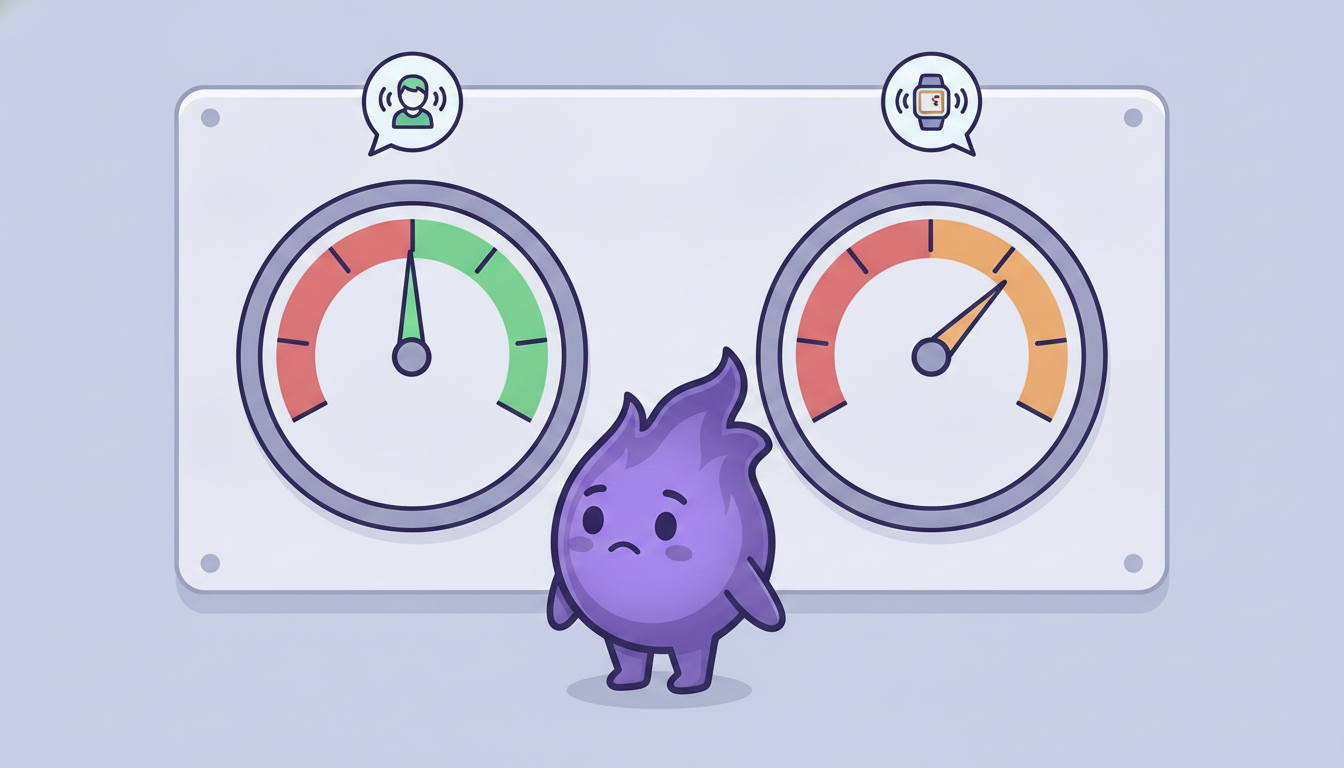
It would be easy to conclude from this that the fix is simply to switch every adherence or condition measure over to a device or sensor instead of asking participants directly. A separate paper on adherence data collected via medication monitoring technology, covering both mobile-phone video applications and electronic pillbox devices, pushes back on that as a complete solution. The authors note that ambiguous adherence data, even when it comes from a monitoring technology rather than a self-report, still adversely affects statistical analysis, study conclusions, and the generalisability of findings. Technology-based measures come with their own limitations and nuances that need to be considered from the point a study is designed, not patched in afterwards once a data quality problem shows up.
The practical implication is that "more objective" doesn't automatically mean "more reliable." A pillbox device that logs an opening event isn't proof a dose was taken, just as a video confirmation has its own gaps around consistency and participant compliance with the monitoring itself. The improvement over self-report is real, but it's a matter of degree, not a switch from unreliable to definitive.
What this means for how a study is actually built
A few practical implications follow directly from both findings:
- Eligibility criteria that depend on a self-reported condition status deserve an objective check at screening, not just at some later study visit. The MedISAFE-BP gap happened at the enrolment stage, which is exactly where getting it wrong has the most downstream consequences.
- Adherence and outcome data collected through any single method, self-report or device, benefits from being triangulated against at least one other source where the study's budget and design allow it, rather than treated as settled because it came from a more "objective-sounding" channel.
- Data quality planning needs to happen at study design, not analysis. Both papers converge on this point from different angles: ambiguous or unreliable adherence data degrades a study's conclusions regardless of which method produced it, and the fix has to be built into the protocol, not bolted on after the fact.
None of this is an argument against self-reported data, which remains genuinely useful for a huge range of outcomes that objective measurement simply can't capture, like symptom experience, quality of life, or anything inherently subjective. The MedISAFE-BP finding is specifically about the risk of leaning on self-report for a judgement an objective measure could settle instead, at exactly the point in a study where that judgement carries the most weight.