
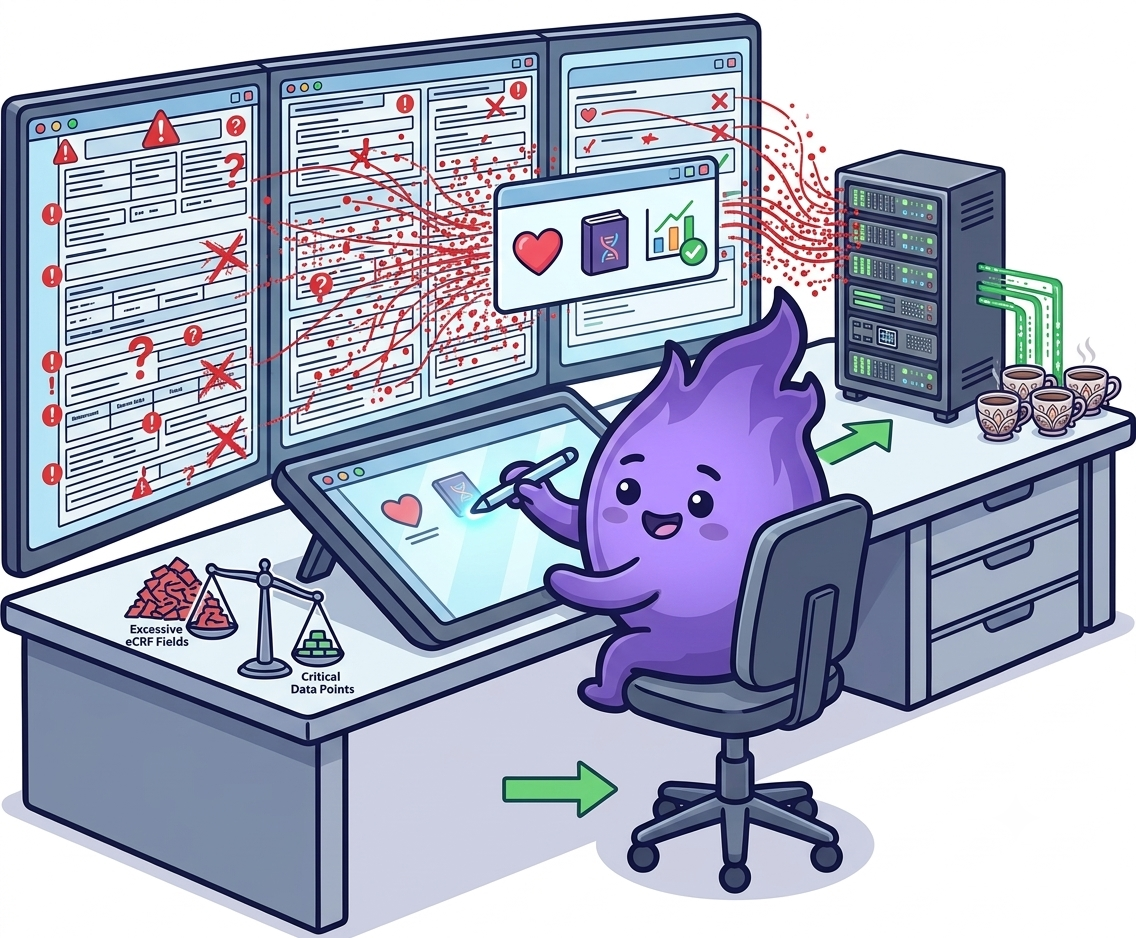
A case for fewer eCRF fields
The instinct to capture "everything just in case" is understandable. But in practice, it creates noise. A bloated eCRF slows data entry, increases site burden, and produces datasets that no one has the time or the mandate to fully explore.
This post makes the case for restraint. Not restraint as an aesthetic preference, but as a practical discipline that has real, measurable downstream effects on how a study actually runs, from the first site initiation visit through to database lock.
Why it happens
The problem usually builds over time, and it rarely happens because of one bad decision. It happens because of many reasonable-sounding small ones:
- Different stakeholders each request "just a few more" fields
- Safety, efficacy, exploratory, and operational metrics blur together into one long form
- Legacy forms are reused without pruning
- No one wants to be the person who says no to a reasonable-sounding request
The result is often hundreds of fields, many of them sparsely completed, inconsistently defined, or collected without a clear plan for how they will be used. By the time anyone notices, the form has become load-bearing in the sense that people are used to it, not in the sense that it's actually structurally necessary.
The real costs of too many fields
Each extra field looks free at the point someone requests it. The cost shows up later, spread across several different people who never see each other's share of the bill.
| Cost | Who feels it | What it looks like in practice |
|---|---|---|
| More training required | Site staff | Longer onboarding, more reference material to memorise before first patient in |
| More queries | Sites and monitors | Incomplete or inconsistent entries in rarely-used fields triggering back-and-forth |
| More monitoring effort | Monitors and CRAs | Every field is surface area to check, whether or not it's ever analysed |
| More participant friction | Participants, during visits | An overlong form extends the interaction and increases the chance of rushing at the end |
None of these costs are dramatic on their own. A few extra minutes here, one more query there. But they compound across every site, every visit, and every monitoring cycle for the length of the study, which is exactly why nobody notices the total until well after the eCRF has been locked in.
What to do instead
- Categorise every field before finalising the eCRF: is this core (must-have), important (likely useful), or exploratory (nice if we get it)? Naming the category out loud, in a document everyone can see, makes it much harder for a field to sneak in under "well, it might be useful."
- Map each field to a specific analysis, process, or decision. If you cannot name one, question whether the field should exist. "Someone might want this one day" is not a mapped use.
- Ask what happens if it is missing. If the honest answer is "probably nothing," cut it. If the honest answer is "we'd have no way to explain the primary result," keep it and prioritise it accordingly.
- Pilot on real users. Do site coordinators understand what is being asked? Can they complete it consistently without guidance? A field that needs a training slide to be filled in correctly is a field that's already asking too much of the person completing it.
Smaller eCRFs are easier to complete, easier to clean, and easier to lock. They also encourage clearer thinking about what the study is actually trying to learn, because a team that has to justify every field ends up with a much sharper answer to "what are we actually measuring, and why" than a team that never had to make the case for anything.
There's a version of this that feels uncomfortable in the moment. Saying no to a stakeholder's reasonable-sounding request is harder than just adding the field and moving the meeting along. But the discomfort of that one conversation is smaller, and happens once, compared to the accumulated cost of every site, every visit, and every query cycle carrying a field nobody quite remembers the reason for.
Sometimes less data really is more useful.