
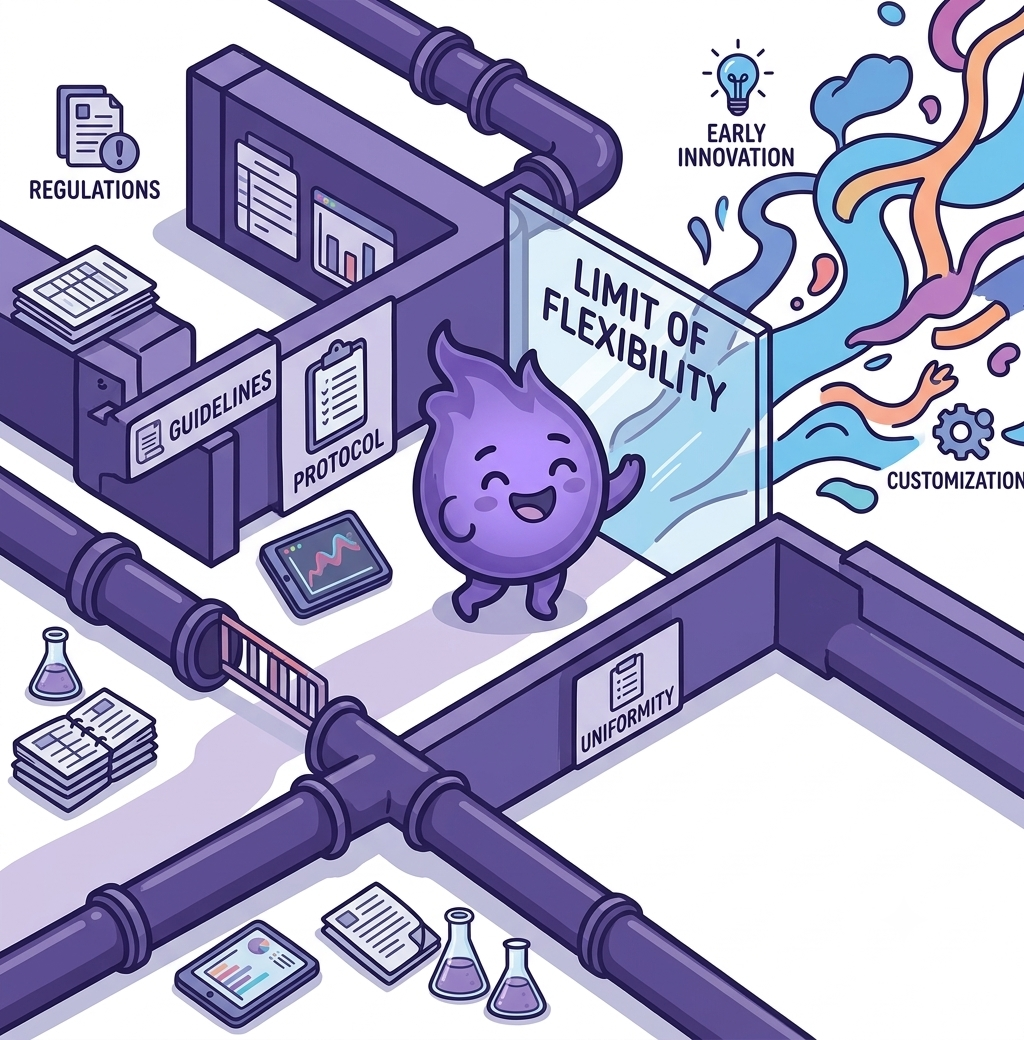
Phase 3 trials and the limits of flexibility
Phase 3 is where scale meets structure. Dozens of sites. Potentially thousands of participants. Tight protocols. Fixed endpoints. Regulators watching closely. When people talk about flexibility in digital trials, Phase 3 is usually where the conversation hits a wall.
And fair enough. You cannot run a large confirmatory study on improvisation.
But flexibility and rigour aren't opposites. Civil engineers figured this out long ago: expansion joints let a bridge respond to heat, cold, and stress without cracking. The structure doesn't move. The system does. The same principle applies here, and there's statistical backing for it: an analysis of source document verification practices found that errors and corrections had minimal effect on study results and conclusions, with the effect shrinking further as study size increased, concluding that on average under 8% source verification was enough to maintain data quality, dropping close to zero for the largest studies. The recommendation wasn't to abandon verification. It was to redirect it toward the data clarification queries that were actually discrepant, rather than checking everything with equal intensity regardless of risk. That's flexibility with rigour attached, not instead of it.
Here's where flexible design can live inside a Phase 3 trial, and where it can't.
| Area | Rigid (good) | Flexible (also good) |
|---|---|---|
| Protocol endpoints | Fixed (no mid-study changes) | n/a |
| Visit scheduling | Protocol-defined windows | Task open/close dates within those windows |
| Query management | Flagged per GCP requirements | Routed by priority, not volume |
| eCRF versioning | Audit trail maintained | Updates don't break historic data |
| Participant interface | Consistent task labels | Graceful handling of skips and delays |
| Role permissions | Defined in advance | Configurable per site without central rework |
Where systems break first
The problems in Phase 3 rarely start with the protocol. They start with the platform. Query workflows that flag every decimal-point deviation instead of tracking patterns. Visit windows so rigid that a participant 25 hours late auto-generates a deviation. eCRF forms that need rebuilding from scratch when a single field changes. These aren't compliance problems: they're design problems. When every edge case becomes an escalation, monitors stop seeing signal. They see noise, which is precisely the failure mode the source-verification research was responding to: treating every discrepancy as equally worthy of scrutiny doesn't produce better data, it produces exhausted monitors and a backlog of low-value checks.
What good design looks like in practice
Task windows that reflect human behaviour. If the protocol allows a visit between Day 5 and Day 9, the platform should open the task on Day 5, allow completion through Day 9, and document the actual date without treating late entries as failures. Participants get sick. They cancel. The data should reflect what actually happened, not a sanitised version of the schedule.
Query routing by priority. Not everything deserves the same response time. A critical lab value needs immediate escalation. A missing optional field does not. Systems that treat both equally guarantee that monitors spend their day chasing the wrong things, exactly the pattern the risk-based monitoring literature has been arguing against for a decade: focus verification effort on what's actually discrepant and risky, not on everything with equal weight.
Forms that update without breaking. Amendments happen. When they do, the eCRF should handle it: preserve historic entries, flag versioning by participant, avoid wiping data that was legitimate under a previous version of the protocol.
Clarity about who can do what. Flexibility creates chaos when roles aren't defined. Who can override a schedule? Who marks an incomplete form as resolved? Who reviews changes and when? The system should make these visible, not just in an SOP document nobody reads, but in the interface itself.
The honest version
Phase 3 doesn't need less structure. It needs better structure: structure that holds firm on the things that matter, like endpoint consistency, data integrity, and GCP compliance, and bends intelligently on the things that don't.
A missed diary entry should not feel like a protocol deviation. A late check-in should not trigger a manual review. A borderline value that matches the pattern of everything else that participant has ever submitted does not need the same scrutiny as a genuine outlier. The trial should run as it was designed, and the system should quietly absorb the reality that humans don't always run to schedule.