
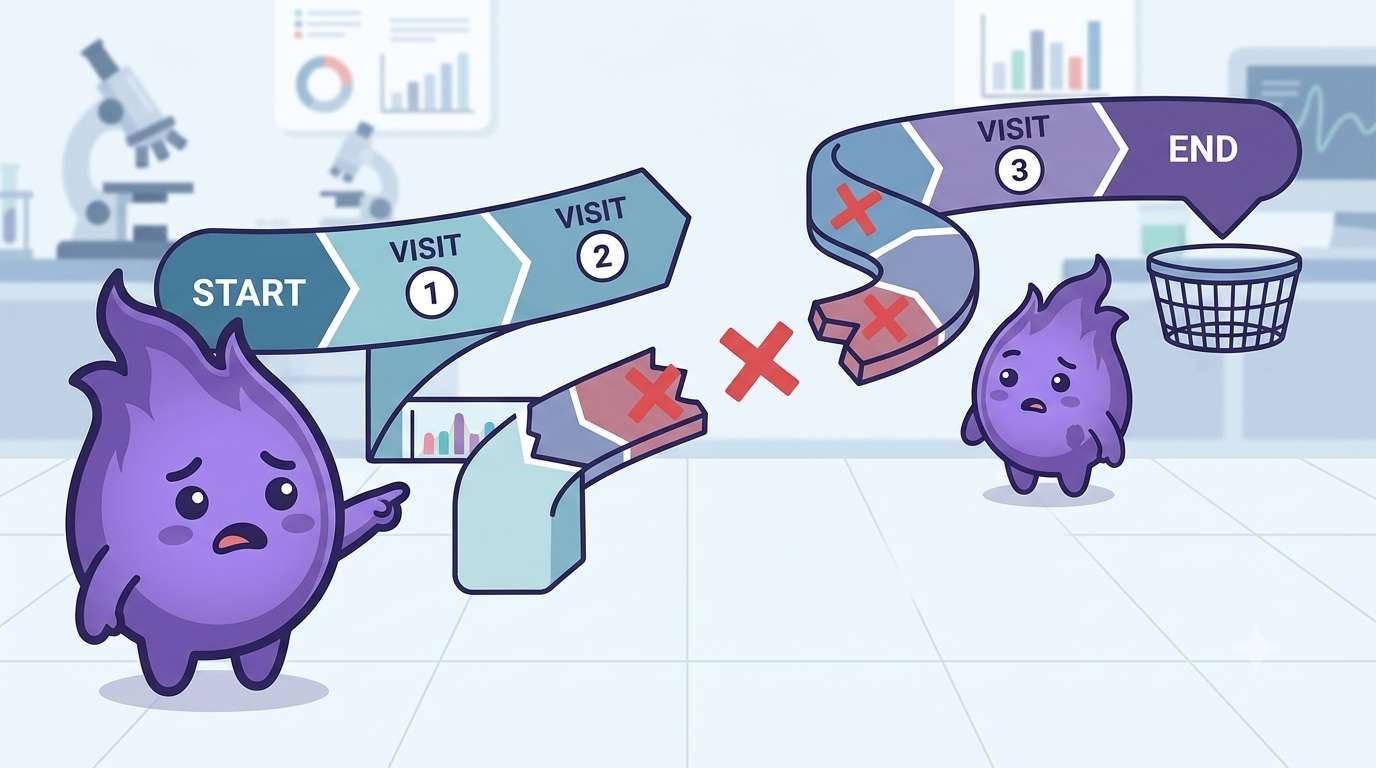
What happens when participants miss the middle of a study
There is a lot of focus on the beginning and end of a participant's journey. Recruitment. Onboarding. Final outcomes. But the middle is often where things quietly go off track, not through dropouts necessarily, but through disengagement.
This is the phase where participants are no longer new and curious, and not yet close enough to the finish line to feel a sense of resolution. Routines start to slip. Diaries get skipped. Responses feel more rushed. People stop checking the app. And because the data keeps coming in, just with more gaps and less attention, it is easy to miss that something has changed.
A study analysing engagement across six digital health cohorts found a more specific pattern than "dropout": the probability of a participant staying in a study held above 80% for the first month across every cohort studied, then settled and stayed above 50% for the entire active period rather than collapsing sharply at any single point. The middle isn't where people leave. It's where they quietly do less without leaving, which is a harder problem to spot because the data doesn't stop arriving, it just gets thinner.
How to spot it
Better detection starts with looking beyond binary compliance. Instead of asking "did they submit?", ask:
- Is the participant still logging, but always at odd hours?
- Are scores becoming strangely repetitive or minimal?
- Has there been a long gap followed by a sudden batch of entries?
- Have they stopped opening the app entirely, even when reminders are sent?
These patterns suggest a participant who is going through the motions or struggling to keep up. It does not always mean they want to withdraw. Often it means they need support.
Why the middle is harder than it looks
The same six-cohort study identified three recurring barriers behind this kind of drift, and they're worth checking against directly rather than assuming the cause:
| Barrier | What it looks like |
|---|---|
| Task fatigue | Repeated, similar-feeling entries wear participants down over a long middle stretch |
| Situational limits | A health, mental, or practical constraint makes the task genuinely harder to complete |
| Low perceived value | The participant no longer sees a clear reason the task matters |
The same research found engagement varied sharply by population: participants managing a more burdensome health condition showed noticeably lower task completion than others, while otherwise comparable groups maintained adherence above 80 to 90%. The barrier a given participant is facing is rarely universal across a study, which is exactly why a single generic re-engagement message tends to underperform a targeted one.
How to respond
Consider interventions that fit naturally into the middle of a study:
- A check-in message that acknowledges the halfway point and thanks them for their contribution
- A short, optional feedback form asking how things are going
- A progress summary showing what they have achieved so far
- A reminder of what is left, and when the study ends
The goal is to re-anchor people, not pressure them. A well-timed message that their input is still valued can restore a sense of purpose. This is especially important in longer or low-touch studies where participants may have had no direct contact with a coordinator for weeks.
How to design for it
Some of this starts at the protocol level. If a study includes a cluster of mid-point assessments, spacing them out and explaining them clearly reduces the likelihood of fatigue at exactly the wrong moment.
Some teams also add light acknowledgements at key milestones: a digital thank-you note, a message from the investigator, a heads-up that their data is making a difference. These do not have to be elaborate. They just need to feel genuine.
And flexibility helps. If a participant disappears for a few weeks and returns, the system should let them pick up where they left off without making them feel like they have broken the rules. Design with the assumption that people will drop off and come back, because the evidence suggests most of them stay engaged at some level even when their contribution thins out.
The middle of a study is where real-world patterns start to show. Treating this phase as an opportunity rather than neutral space between "start" and "complete" is often where the difference between a study that holds together and one that quietly unravels gets made.